
By clicking “Accept All Cookies”, you agree to the storing of cookies on your device to enhance site navigation, analyze site usage, and assist in our marketing efforts Cookies Policy.
Beyond LVM3-X/CARE: Will Gaganyaan Mark a New Era for ISRO?
On the same morning, the LVM3-X rocket made its first flight and carried a Crew Module weighing 3,775 kg as part of the LVM3-X/CARE mission.
On December 18, 2014, the Indian Coast Guard retrieved the Crew Module from the rough waters of the Bay of Bengal. It was located about 1,600 kilometers away from the Satish Dhawan Space Centre in Sriharikota. On the same morning, the LVM3-X rocket made its first flight and carried a Crew Module weighing 3,775 kg as part of the LVM3-X/CARE mission. It reached a suborbital height of 126 km, where thrusters were used to position it for a safe re-entry.
- The LVM3-X/CARE mission refers to a spaceflight project where the LVM3-X rocket, designed to carry heavier payloads and support crewed missions, was used to test and demonstrate technologies for safely transporting crew members. “CARE” stands for Crew Module Atmospheric Re-entry Experiment, focusing on how a spacecraft can safely return to Earth.
- Thrusters are small engines on a spacecraft that help control its movement and orientation in space. They can adjust the position and direction, especially during re-entry or docking maneuvers.
The Crew Module came down using parachutes to land gently in the designated area. It was developed during the early stages of the Human Spaceflight Project, even before the Gaganyaan project was officially approved in 2019.
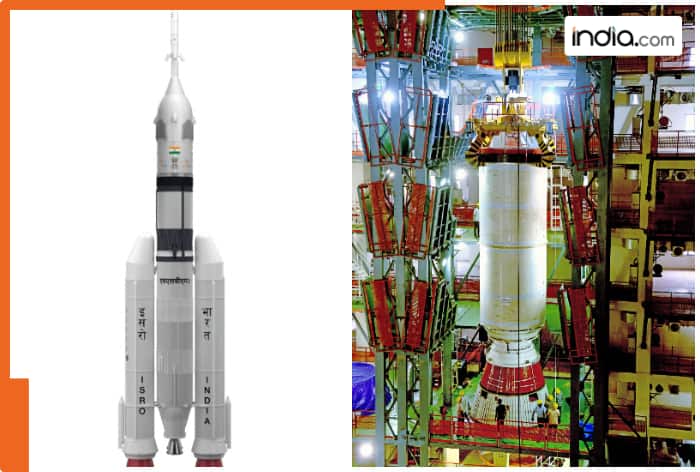
It’s a nice coincidence that ten years later, on the same day, ISRO is preparing for the first uncrewed Gaganyaan mission. They are starting to stack the Human-rated LVM3 rocket, now called HLVM3, at SDSC-SHAR.
- “Stack” (to assemble or arrange components on top of each other) refers to the process of putting together different parts of the rocket in preparation for launch.
ISRO has made significant progress since the LVM3-X/CARE experimental mission. The human-rated launch vehicle, called HLVM3, is based on LVM3 and has been designed with improved reliability to ensure the safety of astronauts.
Additionally, a Crew Escape System (CES) has been put in place to protect the crew. This system allows the Crew Module (CM) to be safely ejected in case of a dangerous situation.The Crew Escape System (CES) works from the moment the rocket launches until the Crew Module separates after flying through the atmosphere.
The HLVM3 is a three-stage rocket that can carry about 10 tons to Low Earth Orbit (LEO). It stands 53 meters tall and weighs 640 tons.
The rocket is being prepared for launch, with the Crew Module and its related systems undergoing final checks at ISRO centers.
The main goal of the LVM3-X/CARE mission was to test the rocket’s flight through the atmosphere and to show how a full-sized Crew Module can safely re-enter Earth’s atmosphere.
The Earth’s atmosphere extends from the surface up to about 10,000 kilometers, but we typically consider the layers up to around 100 kilometers (62 miles) for most spaceflight purposes. Here are the main layers of the atmosphere, starting from the ground:
- Troposphere : Extends from the surface to about 8-15 kilometers (5-9 miles). This is where most weather occurs.
- Stratosphere : Ranges from about 15 to 50 kilometers (9 to 31 miles). The ozone layer, which absorbs harmful UV radiation, is located here.
- Mesosphere: Extends from 50 to about 85 kilometers (31 to 53 miles). This layer is where most meteoroids burn up upon entering the atmosphere.
- Thermosphere : Ranges from about 85 to 600 kilometers (53 to 373 miles). It contains a small amount of particles and is where the auroras occur.
- Exosphere : Extends from about 600 kilometers up to 10,000 kilometers (373 miles to around 6,200 miles). This layer gradually fades into outer space.
Spacecraft typically re-enter the atmosphere from the thermosphere, where they encounter significant atmospheric drag.
The main goal of the LVM3-X/CARE mission was to test how the vehicle would fly through the atmosphere and to show how a full-size Crew Module can safely re-enter Earth’s atmosphere.
The mission reached important technical goals, such as successfully testing the LVM3 vehicle’s flight, ensuring the paired S200 solid rocket boosters worked well together, operating the twin Vikas engines in the L110 stage, coordinating control between the L110 and S200 stages, and managing complex separation systems.
- The LVM3 rocket has three main stages:
1.S200 Solid Rocket Boosters :
– These are two powerful solid rocket boosters located on either side of the rocket. They provide the initial thrust needed to lift the vehicle off the ground and through the lower atmosphere. They burn solid fuel and are designed to operate in tandem to maximize lift-off power.
2.L110 Liquid Core Stage :
– This stage uses liquid fuel and is responsible for continuing the ascent after the boosters have burned out and separated. The L110 stage houses two Vikas engines that provide thrust and help steer the rocket. It operates until the vehicle reaches a high altitude where the atmosphere is thinner.
The L110 stage of the LVM3 rocket uses Liquid Oxygen (LOX) and RP-1 (a refined form of kerosene) as propellants. This combination allows for efficient combustion, providing the necessary thrust to continue the ascent after the solid rocket boosters have separated. The use of liquid propellants also enables better control and performance during flight.
3.C25 Upper Stage :
– This is the final stage of the rocket, which uses liquid fuel to place the payload into its intended orbit. The C25 stage has a single engine and is designed for precision manoeuvring, allowing for the delivery of satellites or other payloads into various orbits. It also performs any necessary orbital adjustments before deployment.
Each stage plays a crucial role in ensuring the successful launch and deployment of payloads into space.
The success of the LVM3-X/CARE mission confirmed that all the steps involved in integrating, assembling, testing, and preparing the rocket for launch worked well. It also validated the mission planning and simulation processes, making sure everything is ready for future missions.
The CARE experiment was designed to test how well the Crew Module handles heat during re-entry and to confirm important technologies needed for safely returning to Earth.
It successfully showed how blunt-body shapes handle re-entry, how well thermal protection systems work, how parachutes slow down the module, and the processes for recovery. This provided important information for future improvements.
The success of the LVM3-X/CARE mission was a key step for ISRO in becoming able to launch heavier satellites on its own. Since then, the LVM3 has successfully completed seven launches in a row.The information gathered from the CARE mission has played a crucial role in developing ISRO’s human spaceflight program. Changes in the Crew Module design, along with later pad abort tests, air-drop tests, and test flights, are based on the important data collected from CARE.
The LVM3 has been approved for human use, and all its systems have been tested to ensure they are more reliable.
Ground tests and flight tests conducted in unusual conditions have confirmed that these systems perform well and meet safety standards for humans. This means that even in unexpected situations, the systems are designed to keep people safe.
The introduction of the reliable Crew Escape System (CES) has boosted confidence in the manned missions planned by ISRO. This system allows the crew to escape safely during all stages of ascent, right up until the module is injected into orbit.
As India gets ready for its first human spaceflight with the Gaganyaan program, the lessons learned from the LVM3-X/CARE mission are more important than ever. The Crew Module, built with extra safety features and backup systems, will be launched on the human-rated LVM3, ensuring the safety of the astronauts, known as Gaganyatris.
The information collected from the uncrewed flights will be crucial for the success of the crewed missions. Additionally, the experience gained from the Gaganyaan program will be important for building and operating the Bharatiya Antariksh Station (BAS).
This ambitious effort shows ISRO’s long-term vision and planning to build on its existing achievements to improve India’s space industry.
At 8:45 AM on December 18, 2024, at SDSC, the assembly of the nozzle end segment with the full flex seal nozzle of the S200 motor began. This marked the official start of the launch campaign for the HLVM3-G1 / OM-1 mission.
The flex nozzle for the S200 motor is a component designed to provide flexibility during rocket launches. This flexibility allows the nozzle to adapt to changes in pressure and thrust, improving the rocket’s performance and stability during flight. It helps control the direction of the exhaust gases, which enhances maneuverability and efficiency, making the launch more effective.
The preparation of both S200 motors will now involve assembling the segments, control systems, and avionics. The L110 and C32 stages for the HLVM3 are already set up at the launch complex. The crew escape system components have also arrived at SDSC. Meanwhile, the Crew Module is being integrated at VSSC, and the Service Module is being put together at URSC. After that, the Orbital Module (OM) will undergo integration and testing at URSC in Bangalore.